If you own a home outside the municipally serviced core of Halifax and Dartmouth, there is a good chance your wastewater never reaches a municipal sewer. The Province estimates that about 45 per cent of Nova Scotia homes rely on an on-site septic system, and that covers a lot of the properties I sell in places like Fall River, Hammonds Plains, Porters Lake, Lawrencetown and along the Eastern Shore.
Most of the time a septic system works quietly in the background. When it stops draining the way it should, one of the first things a septic company may suggest is a septic bed flush. Buyers and sellers ask me about it often (twice in as many months), usually in the middle of a transaction when a slow drain or a wet patch on the lawn has turned up in an inspection. Here is what it is, when it helps, and what your options are when it doesn’t.
What is a septic bed flush?
A septic bed flush is a cleaning of the perforated pipes in your disposal field using a high-pressure water jet. You may also hear it called a field flush, line flushing or line jetting. The Province’s term for the bed itself is the disposal field, and many people simply call it the septic field or leach field.
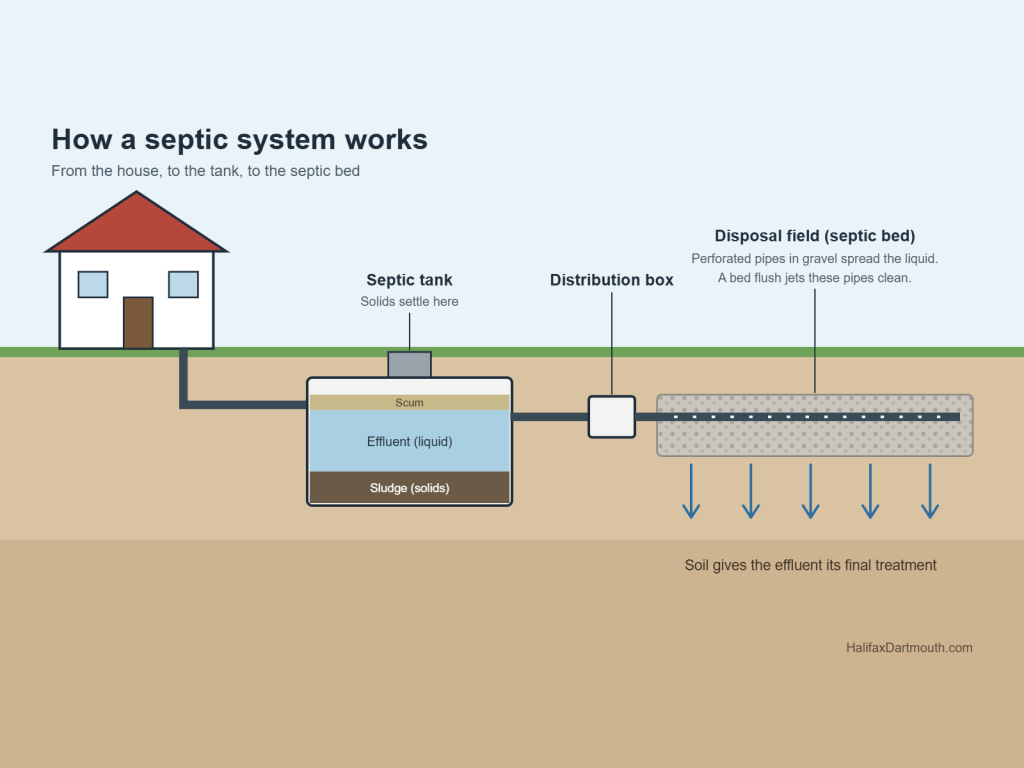
It helps to picture how the system works. Wastewater leaves the house and enters the septic tank, where solids settle to the bottom and grease floats to the top. The liquid in the middle, called effluent, flows out to the bed, where a network of perforated pipes spreads it through gravel and into the soil for final treatment.
Over the years, fine solids, grease and sometimes tree roots can work their way into those pipes and block the small holes. When that happens the effluent can’t spread evenly, and the system starts to back up or surface. During a flush, a technician opens an access point, feeds a jetting hose down each line and scours the pipe and its perforations. The loosened material is then removed, usually along with a pump-out of the tank.
A flush cleans the pipes. It does not clean the gravel or the soil around them, and that distinction matters.
How do you know if you need one?
You might need a flush if the system is showing signs of a blocked bed and the simpler causes have been ruled out. The warning signs the Province lists in its Homeowner’s Guide to Septic Systems are worth knowing:
- Toilets, tubs or sinks that drain slowly or back up, especially on laundry day
- A sewage smell in the yard or the basement
- Pooling water or soggy, muddy ground over the bed
- Strips of unusually bright green grass above the field lines
None of these proves the bed pipes are the problem. The same symptoms can come from a blocked pipe between the house and the tank, a tank that is overdue for pumping, a broken baffle or a clogged outlet filter. A good technician works from the house outward: the plumbing first, then the tank, then the field.
A flush becomes the likely next step when the tank has been pumped and inspected and the trouble continues, or when a camera inspection shows solids or roots in the field lines. It is also worth asking whether the problem is constant or only shows up after heavy water use or heavy rain, because that points to different causes.
If you are buying a home with a septic system, a septic inspection as a condition of your offer is the time to find this out.
Who should you call?
Call a certified septic company that has jetting equipment. Several septic service companies in the Halifax area advertise bed flushing or line flushing alongside tank pumping and camera inspections, so it is usually one phone call.
In Nova Scotia, the people who work on septic systems must be certified by Nova Scotia Environment and Climate Change. There are three certificates you are likely to run into as a homeowner. A Septic Tank Cleaner pumps, cleans and maintains systems. An Installer constructs and installs them. A Qualified Person, often shortened to QP, assesses a property and selects the system that suits it, and a professional engineer handles the designs that fall outside the standard options.
For a flush, start with the septic tank cleaner. If the flush turns into a repair, an installer and a Qualified Person will become involved.
Before you hire anyone, the Province suggests you confirm their certification, get three written quotes, ask for references and make sure they carry liability and workers’ compensation coverage. You can check a certificate by emailing the department at ecccompliance@novascotia.ca or by contacting a regional office.
What if the flush doesn’t fix the problem?
If a flush doesn’t restore drainage, the blockage is most likely in the gravel or soil around the pipes, and that calls for a repair or a replacement. The Province’s technical guidelines on repair are direct about this: jetting often clears the pipe and its perforations, but it will not help when the gravel or the soil pores are plugged.
The usual culprit is a thick biomat, a biological layer that forms where the gravel meets the soil. Some biomat is normal and part of how the bed treats wastewater. Too much of it, or soil that has been compacted by vehicles or saturated by groundwater, stops the bed from absorbing water.
At that point the steps look like this:
- Have a Qualified Person assess the system and identify the cause.
- Notify Nova Scotia Environment and Climate Change. Repair work on a septic system needs the department’s approval, apart from minor alterations defined in the regulations.
- Have a certified installer carry out the approved work.
The fix depends on the cause and the lot. It may be as modest as cutting water use, adding an effluent filter and resting the field so some capacity returns. It may mean adding a trench, which the guidelines describe as one of the most common field repairs. On a tight or difficult lot it can mean a full replacement with a different type of system, such as a sand filter.
A replacement is a major expense, often well into five figures, so get more than one quote. If you are selling, a known septic problem belongs on your Property Disclosure Statement, and it is far better to deal with it before listing than to have it surface during a buyer’s inspection. If you are buying, the inspection results give you room to negotiate a repair, a price adjustment or a holdback.
How can you avoid needing one?
Regular pumping is the single best protection, because it stops solids from leaving the tank and reaching the bed. The Province’s homeowner guide recommends an assessment at least every three years and a pump-out every three to five years, and its website suggests every two to three years for heavier use. A larger household or a smaller tank means a shorter interval.
Beyond pumping, a few habits make a real difference:
- Watch what goes down the drain. Wipes, paper towels, dental floss, feminine hygiene products, coffee grounds, cat litter, grease and food scraps all belong in the garbage or the green bin. Keep paint, solvents and harsh cleaners out as well.
- Spread out your water use. One or two loads of laundry a day is easier on the bed than six on a Saturday. Fix running toilets and dripping taps.
- Protect the bed. Don’t drive or park on it, and plant only grass over it. Tree and shrub roots will find the pipes.
- Keep extra water away. Direct roof drains, sump pump discharge and surface runoff away from the field, and don’t send water softener backwash into the system.
- Clean the outlet filter. If your tank has one, rinse it with a garden hose once a year.
- Skip the additives and the garburator. The Province advises against septic additives, and a garbage disposal sends extra solids and grease to the tank.
Keep your pumping receipts, the system approval and the Certificate of Installation together. They help a technician find and assess the system, and they are exactly what a buyer’s agent will ask for when you sell.
The bottom line
A septic bed flush is a reasonable, relatively low-cost first step when the pipes in your field are clogged, and it often buys a healthy system many more years. It is not a cure for a bed that has reached the end of its life, and a good septic professional will tell you which situation you are in.
If you are thinking about buying or selling a home with a septic system anywhere in the Halifax Regional Municipality, I am happy to talk through what to look for and what questions to ask. You can reach me at 902-240-0768 or dale@halifaxdartmouth.com.
Dale Cameron, REALTOR®, RE/MAX Nova | Halifax-Dartmouth.ca
Facebook | Instagram | TikTok | LinkedIn
This article is general information and not a substitute for an assessment by a certified septic professional.
Sources
- On-site sewage disposal systems, Nova Scotia Environment and Climate Change
- A Homeowner’s Guide to Septic Systems, Province of Nova Scotia
- On-site Sewage Disposal System Technical Guidelines, Section 7: Repair and Rehabilitation, Nova Scotia Environment
- On-site sewage industry certificates, Province of Nova Scotia
- Sewer bed flushing, MacKenzie Environmental, for how a local provider describes the service

Leave a Reply